
 Red wine
  dry
dry  Germany
  Ahr
Ahr Delivery time approx 2-4 workdays
Tradition, terroir and irrepressible passion: The VDP estate Deutzerhof on the Ahr
In the narrow valleys of the Ahr, lined with rugged rocks, a winegrowing region reveals itself that is unmatched in Germany – and perhaps even worldwide. Here, where the river has carved its way through hard rock over thousands of years, ancient vines cling to the steepest slopes. It is in this dramatic and breathtaking setting that a very special jewel of German wine culture is located: the Deutzerhof estate. As the embodiment of delicate, profound and expressive red wines, the estate has earned itself an excellent reputation far beyond Germany’s borders. We now take you on a detailed journey through the history, philosophy, unique sites and masterful winemaking of this outstanding estate.
The soul of the Ahr – Introducing the Deutzerhof estate
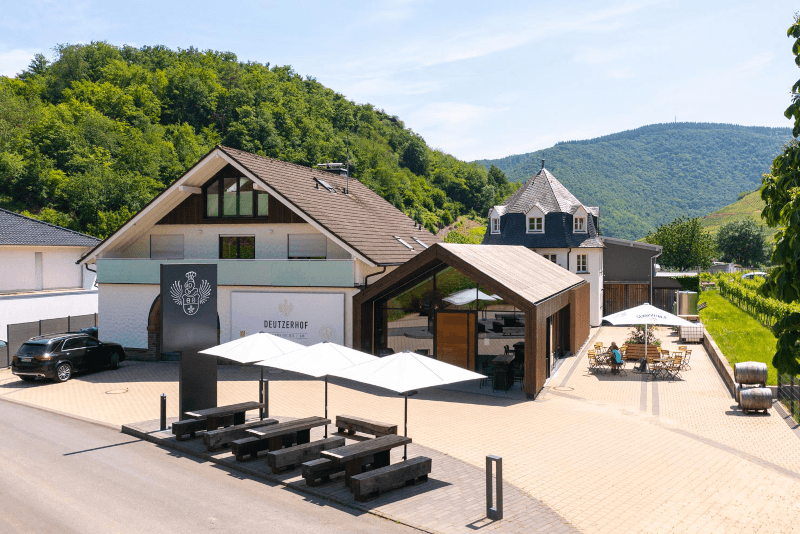
Anyone who travels through the Ahr valley immediately senses the magic of this place. In the midst of the vineyards of the famous Mönchberg, right on the idyllic edge of the red wine metropolis of Mayschoß, lies the home of the Deutzerhof estate. It is the smallest VDP (Verband Deutscher Prädikatsweingüter) estate on the Ahr and cultivates around 6 hectares of precious vineyard area with a highly motivated team of five. This manageable size is no coincidence, but a deliberate choice: it allows the team to know every single vine intimately and to work both in the vineyard and in the cellar with a dedication that often gets lost in larger operations.
The founding of the winegrowing business in the family goes back to a very long tradition. As early as 1574, the vintner Caspar Cossmann was documented together with his wife Catherina as a winegrower in Mayschoß in a debt register of the castle of Are. This laid the foundation for a centuries-long family history dedicated to wine. Another milestone was the year 1952, when Alfred Cossmann, a direct descendant, made the bold decision not to deliver his grapes to the local cooperative anymore, but to market them himself and produce his own wines.
The estate only received the name “Deutzerhof” in more recent history. In 1977, daughter Hella Cossmann married the tax specialist Wolfgang Hehle. Hehle, a career changer with an irrepressible passion for wine, rapidly drove the development of the estate forward. As the old family house soon burst at the seams, a completely new, modern winery building was erected in 1980 on the so‑called “Deutzerwiese” – the present‑day Deutzerhof was born. Wolfgang Hehle revolutionised the estate’s style, focusing on strict yield reduction and nature‑oriented cultivation. In 1994, this pioneering qualitative role was rewarded with admission to the elite VDP.
After the painful loss of Wolfgang Hehle in 2013, his wife Hella continued to run the estate together with the accomplished general manager and cellar master Hans‑Jörg Lüchau. In January 2020, a new chapter began: Hella Hehle handed the estate over to Jürgen Doetsch, a long‑time friend of the family. Under the leadership of owner Jürgen Doetsch and the proven cellar master Hans‑Jörg Lüchau, the clear wine style and unmistakable soul of Deutzerhof have been seamlessly continued to this day.
The philosophy of the Deutzerhof estate: quality, sustainability and deep respect for nature
The philosophy that shapes every step of work at Deutzerhof can be summed up by a clear credo: mindful handling of soils, vines and grapes. Quality here does not begin in the cellar, but exclusively outside in the steep, sweat‑inducing nature. The goal of the five dedicated employees is to work out the absolute maximum expression of terroir from every vintage and every vine.
A central pillar of this philosophy is lived sustainability. The Deutzerhof estate is a proud member of Fair and Green e.V. and undergoes a strict annual sustainability audit according to FAIR'N GREEN guidelines. In practice, this means the consistent renunciation of environmentally harmful practices, the protection of biodiversity in the vineyards and the preservation of the ancient cultural landscape. The partially crumbling, centuries‑old dry‑stone walls in the extreme steep sites have been restored by the estate in painstaking manual labour. These walls not only support the terraces, but also serve as a valuable biotope for numerous, in some cases endangered animal and plant species, such as warmth‑loving lizards and rare insects. Deutzerhof thus sees itself not only as a wine producer, but as a guardian of a historic cultural landscape.
The growing region and its special features: Why the Deutzerhof vineyards are so unique
The Ahr growing region is located in the north of Rhineland‑Palatinate and is considered one of the northernmost winegrowing regions in Europe. Anyone who thinks that no great red wines can emerge here in the cool north is impressively proven wrong by the wines of the Ahr. Although the Ahr valley lies so far to the north, red grape varieties are grown on around 80 percent of the area – an absolute rarity.
The geographical and climatic conditions make this narrow valley a true hothouse. The vineyards of Deutzerhof are mostly located in prime, south‑facing steep slopes. Above the vineyards, a dense forest rises, shielding the sensitive vines from icy cold spells in winter and spring. But the real secret of the Ahr is its geology, which functions like a gigantic, natural underfloor heating system with a night storage effect.
The soils, the bare rocks and the dark vineyard walls consist mainly of dark slate and greywacke. When the summer sun beats down on these steep, south‑facing amphitheatres, the dark rock heats up intensely. Even on cooler nights, the slate and walls continuously release this stored solar warmth back to the vines. The result is an almost Mediterranean microclimate. Even very late‑ripening and warmth‑loving varieties such as Spätburgunder or Riesling can reach full ripeness here and develop an aromatic density that is admired worldwide for its elegance and finesse. The soils are extremely barren. Above the massive slate bedrock, there is often only an ultra‑thin layer of humus. The vines are therefore forced to drive their roots metres deep through tiny crevices in the hard rock in order to access water and vital nutrients. This struggle for survival of the vine is later reflected in the glass in the form of vibrant, cool minerality and an unmistakable depth.

The vineyard sites and grape varieties: The valuable treasure of the Deutzerhof estate
The Deutzerhof estate cultivates a number of historic, first‑class sites, some of which are classified by VDP statutes as “VDP.Große Lage” or “VDP.Erste Lage”. To make cultivation of these extremely steep slopes possible at all, the estate uses a monorack rack railway that transports materials and, during harvest, the precious grapes down the steep slopes. The most important sites are presented in detail below:
Altenahrer Eck:
This site is breathtaking and resembles a massive rock wall. After Altenahr, the valley narrows drastically and the vineyards rise steeply in ancient terraces up to 300 metres high. The site is characterised by pure slate. Even the topsoil is covered with small slate fragments that reflect the sun. Some old, ungrafted vines that have penetrated deep into the rock still stand here. The Spätburgunder from the Eck are among the most delicate and mineral wines in the entire Ahr region.
Mayschosser Mönchberg:
This site has a historical connection to the eponymous Deutzerhof. As early as the late Middle Ages, monks from the Deutz monastery owned an outpost at the foot of this vineyard. Due to its natural curvature, the vineyard captures the sun’s rays from morning to evening like a parabolic mirror. In addition to slate and greywacke, the soil also contains a fine proportion of clay, which gives the wines a warm, soft component alongside the cool minerality.
Ahrweiler Daubhaus (VDP.Erste Lage):
This site was upgraded as part of the reorganisation of the VDP sites in 2023. The soil mixture of slate, loam and clay, combined with extreme sunlight, produces powerful and structured wines. Vines over 50 years old stand here, providing impressive concentration.
Neuenahrer Im Kuckstein:
Formerly part of the famous “Kirchtürmchen”, this name for the single plot was newly registered in order to highlight the southern, perfect orientation of this parcel. The vines stand protected in a valley basin. A thick layer of clay over slate produces wines of immense juiciness and opulent fruit.
Heimersheimer Landskrone:
A terraced top site near an ancient volcanic cone. Here, slate mixes with loam, loess, greywacke and basalt. In this site, too, Deutzerhof cultivates old, partly ungrafted vines that produce wines with inimitable spice.
In addition, Deutzerhof cultivates parcels in the sites Mayschosser Laacher Berg, Recher Herrenberg, Dernauer Schieferley, Ahrweiler Rosenthal and Neuenahrer Schieferley.
Which grape varieties are grown?
The Deutzerhof estate clearly focuses on red wine, but also maintains an exciting proportion of white wines. The cultivated grape varieties are reflected in the following list:
- Spätburgunder (Pinot Noir): 65% – The undisputed queen of red wine grapes on the Ahr, capricious but, in the hands of Deutzerhof, a guarantee of world‑class wines.
- Frühburgunder: 11% – A rare, Ahr‑typical mutation of Spätburgunder that ripens earlier and produces particularly dense, velvety red wines.
- Chardonnay: 11% – Ideal for powerful, elegant white wines that are often aged in wooden casks.
- Riesling: 9% – Germany’s flagship variety finds fantastic minerality in the slate of the Ahr.
- Dornfelder: 2% – Usually cultivated as a fruity complement.
- Regent: 2% – A robust, fungus‑resistant grape variety.
Winemaking methods: A fine touch in the Deutzerhof cellar
When the grapes in the steep slopes have reached perfect physiological ripeness, harvest begins. This is, of course, carried out by hand in several passes (selective hand harvest) to pick only perfectly sound and ripe fruit. The gentle handling that began in the vineyard is seamlessly continued in the winery’s cellar.
The must and grapes are carefully processed with state‑of‑the‑art equipment. A central role in Deutzerhof’s winemaking is played by spontaneous fermentation. This means that the must is not inoculated with industrially produced cultured yeasts, but is fermented exclusively by naturally occurring wild yeasts originating from the vineyards. This is a riskier but far more rewarding path, as it allows the wines to transport their authentic sense of origin – their terroir – into the bottle without adulteration.
When asked whether the wine is matured in wooden barrels or only in stainless steel tanks, the answer is: both! At Deutzerhof, this decision is made in a highly individual way and always depends on the specific site, vintage and grape variety.
Lighter white wines, delicate rosés and estate wines, where primary fruit and vibrant freshness should be in the foreground, are often matured in temperature‑controlled stainless steel tanks. The more complex village wines and, above all, the Großes Gewächs wines (VDP.Große Lage) require time and oxygen in order to smooth out their tight tannin structure and develop their aromatic depth. These premium red wines therefore mature for many months in traditional large wooden casks as well as in small barriques (225 litres). Here too, cellar master Hans‑Jörg Lüchau demonstrates a fine touch: by skilfully combining both new and used barriques, he ensures that the delicate Burgundy fruit is never overwhelmed by toasty oak aromas. The wood does not serve as a flavour donor, but as a framework that gives the wine structure and longevity.

Award‑winning wines with proper names: The liquid legends of the Deutzerhof estate
In the range of Deutzerhof, there are special wines that do not only bear a vineyard name on the label, but also have their own proper names. These names tell a story and reflect the estate’s history.
The “Caspar C.” and the “Caspar Reserve”: The proper names containing the word “Caspar” are a loving homage to the estate’s founding father, Caspar Cossmann, who was documented in 1574. Until recently, the outstanding Spätburgunder from old vines in Ahrweiler Daubhaus bore the name “Caspar C. Alte Reben”. Another top wine is the “Caspar Reserve Spätburgunder trocken”. These wines are characterised by enormous power and concentration, making the estate’s heritage and tradition tangibly experienceable in liquid form. Dark berry fruits, fine spice and an incredibly long, mineral finish are the hallmarks of these legends.
The “A & O” Frühburgunder: Another wine with a proper name is the “Mayschoss Frühburgunder A & O”. The name plays with the biblical metaphor of Alpha and Omega (the beginning and the end), symbolising the perfection and all‑embracing nature of this wine. Frühburgunder, already a speciality of the Ahr, here shows itself in its most opulent form: velvety tannins, intense notes of black cherry and dark chocolate, and a beguiling creaminess make it a true experience.
In addition, the estate naturally shines with its VDP.Große Gewächse (GG), which do bear vineyard names, but are traded in the wine scene almost like proper names, such as “Eck Spätburgunder GG”, “Mönchberg Spätburgunder GG” or “Kirchtürmchen GG”.
Awards and recognition: Stellar moments for the Deutzerhof estate
Anyone who pursues quality with such consistency does not go unnoticed by the specialist world. Deutzerhof ranks among the absolute top estates on the Ahr and is showered year after year with top scores and awards from renowned critics. A small selection of the most recent honours reads like a who’s who of wine criticism:
- Spätburgunder of the year: In the “Ahrwein des Jahres” tasting, the “Mönchberg Spätburgunder GG 2023” was honoured in the cult class as Spätburgunder of the year.
- Frühburgunder of the year: The same honour went to the “Mayschoss Frühburgunder A & O 2022”, which won the Frühburgunder of the year category.
- VINUM Red Wine Prize 2025: Here the estate triumphed as a “red giant”, taking an incredible nine awards: three times 95 points, twice 94 points, twice 93 points and twice 92 points.
- Vinum Weinguide 2023: The wine guide awarded Deutzerhof the coveted special prize “Rising Star of the Year” for the Ahr region.
- LagenCup Rot 2023: The “2020 Herrenberg Frühburgunder GG” became “Best of the Vintage” with an impressive 93 points.
- wein.plus: The “2018 Caspar Reserve Spätburgunder trocken” achieved the rating “outstanding” with 90 WP (wein.plus points).
On top of this come consistently top ratings in standard works such as Eichelmann, Gault&Millau, Falstaff, Feinschmecker and Henris. For the estate, these high scores and stars are far more than just decoration. They are a confirmation of the hard, quality‑driven work in the vineyard and cellar. They reinforce Deutzerhof’s reputation as one of Germany’s leading Burgundy producers and secure the trust of a demanding clientele.
Conclusion: A bright outlook for the Deutzerhof estate
In summary, Deutzerhof represents a unique symbiosis of more than 400 years of family tradition and forward‑looking, modern winegrowing craftsmanship. The combination of the extreme, heat‑retaining slate steep slopes of the Ahr, an irrepressible respect for nature and masterful artisanal winemaking turns the estate’s wines into true works of art. Whether the crisp estate Riesling, the smooth rosé or the majestic Großes Gewächs wines from wooden casks – every drop is an authentic ambassador of its origin.
The outlook for the future is also promising. With the construction of the new, spacious vinotheque – the so‑called “Weinscheune”, completed in 2021 and complementing the charming tower building from 1995 – owner Jürgen Doetsch has created an inviting place to welcome wine lovers. Exciting events are planned, such as regular vintage presentations, exclusive four‑course menus with restaurateur friends and participation in high‑profile regional events like “Pinot on Slate”. Deutzerhof will continue its path of uncompromising quality undeterred – to the delight of all those who have the privilege of swirling these extraordinary wines from the Ahr in their glass.

More information about Deutzerhof
 http://www.deutzerhof.de/
 https://www.facebook.com/Deutzerhof?fref=ts
  0 26 43 - 72 64
  0 26 43 - 32 32
 | Address | |
|---|---|
| Company Name: | Deutzerhof |
| Street: | Deutzerwiese 2 |
| City: | 53508 Mayschoß / Ahr |
| Country: | Germany |
| Region: | Ahr |
| Continent: | Europe |
| Company | |
| Year of Incorporation: | 1574 |
| Company Owner: | Jürgen Doetsch |
| Managing Director: | Hans-Jörg Lüchau |
| Wine | |
| Cellarmaster: | Hans-Jörg Lüchau |