 Italy
Italy  Piedmont
 delivery time approx 6-9 workdays
Distillerie Berta - from wine, pharmacies and spirits
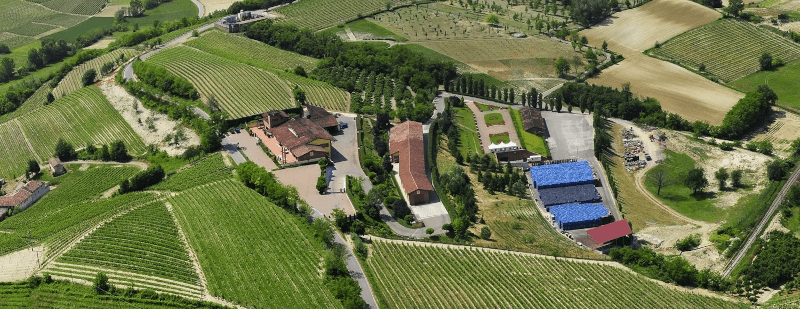
Distillerie Berta is located in the village of Mombaruzzo, on the road between Asti and Genoa in Piedmont. The history of the distillery begins with Francesco Berta, who was born into a peasant family in 1866. Thus he comes into contact with wine at an early age. He begins early to look for outlets beyond the village to expand his business. Soon the children Giovanni and Michele are born. Giovanni inherited his parents' winery, Michele became a pharmacist, an unusual decision at the time. However, it turned out to be a great success, as Michele, with great creativity, designed various tinctures and liqueurs, for which he was able to obtain some raw materials or even whole wines from his brother, such as a Barbera blended with cinchona bark or an elixir made from Moscato.

Through the pharmacy in Milan, it was possible to build up supra-regional contacts in Genoa, Turin, Brescia, Bergamo and other cities, so that a reputation could be gained and even the drastic time after the 1st World War, which was strongly felt in the wine production, the family could survive relatively easily. The grandson Paolo graduated in viticulture in 1947 and took over the winery from father Giovanni. At the same time, he founded the Distilleria Berta di Berta Paolo, in order to be able to continue using the residual products of wine production for grappa. Soon the company's spirits became famous in the area. The meetings with spirits connoisseurs from Germany, Switzerland, America and Australia, who became aware of the Berta grappa during trips to Italy and gave Paolo valuable tips, turned out to be fateful.
The further rise of the family is marked by all kinds of farsighted decisions, so they invent their own bottle and turn to specialized trade and gastronomy at an early stage. The following generations enter the business, Paolo and his wife Lidia, who had also strongly influenced the years up to then with her work, retire in 1990. Today their son Gianfranco is in charge of production and their second son Enrico is in charge of marketing, assisted by their wives Simonetta and Elisabetta. With Annacarla and Giulia, the next generation is already waiting in the wings on both sides. The Bertas say even jokingly that the women in the family are slowly taking the scepter.
The distillation process at Distillerie Berta
Distillation is the art that allows to extract and concentrate what is in the raw material, the marc. The quality of a good grappa depends first of all on the marc, which must necessarily be fresh and healthy.
The Berta System
In order to guarantee the best possible preservation of the marc not only during storage but also during transport, the Berta family has developed an innovative collection system in special containers made of food-grade plastic (200 kg). The marcs, which come from all regions of Italy, are kept fresh and moist thanks to this special type of preservation. A natural fermentation process takes place in a hermetically sealed container, during which the sugar is transformed into alcohol, producing carbon dioxide. The oxygen that is in the containers escapes through a small vent valve on the lid. In the absence of oxygen, the marc does not come into contact with harmful microorganisms in the air and water.
Another peculiarity of this storage is the traceability of the product, guaranteed by a system that indicates the origin and type of pomace, important information for the transparency of the relationship between producer and consumer.
The types of marc
The distillery can be supplied with different types of marc:
- Fermentation marc
- Half fermented marc
- Raw marc
The fermentation marc remains in contact with the must until it becomes wine. The pomace can be distilled immediately after racking, as the grape sugar has been completely converted into alcohol. Mostly the pomace comes from red grapes.
Raw marc is separated from the must immediately after pressing before fermentation. The sugar content has not yet been converted to alcohol, so distillation cannot take place immediately after racking. The pomace is stored in the aforementioned containers for fermentation. Raw marc mostly comes from white grapes.
Half-fermented marcs were only partially fermented with the must. They can be distilled immediately if the unconverted alcohol is left out, or if they are stored until they are fully fermented. These marcs come from red or white grapes.

The distillation process
After the end of fermentation, the process is entirely artisanal, carried out with the utmost care by the master distiller. The fermented marcs go directly into the stills with steam to fill the baskets in each pot still. Once the still is filled, the master distiller allows a hot steam to pass through the moist skins of the marc, which on its way up extracts from the marc the alcohol previously produced during fermentation.
The alcohol vapour thus obtained is sent to the column, which frees it from the less concentrated alcohol water vapours and allows the degree to be raised. The concentrated alcohol vapour reaches the top of a cooler and then, after condensing, enters a basin for degree control: it is just a slow drip that expresses the dedication and patience of the craft.
Thanks to the mastery of the distillers and the modern control systems, the heart is separated from the fore-run (the bitter part) of the distillation process. The different types of equipment also allow the distillation of different raw materials, in addition to the marc: thus it is possible to obtain exquisite brandy also from the wine and directly from the grapes.
Sustainable production
The Berta family's philosophy is clear: quality over quantity, for a demanding clientele that loves the bouquet of flavours and fragrances that have distinguished Berta grappas for decades. A new philosophy is born: grappa is no longer a simple digestif, a sub-product with an aggressive and strong taste, but a great distillate to enjoy and meditate on, resolute and at the same time harmonious in its nuances. The distilled pomace is collected and sold to a company that extracts grape seed oil from the seeds. After this process, the pomace is further processed to obtain fuel.
The storage of the grappae of the Berta distillery
The distillate produced is stored in stainless steel containers. Once it has certain organoleptic characteristics, it is bottled in barrels made of different types of wood for slow aging. The length of time spent in wooden barrels is then the key to making a basic distinction between refined and aged grappas. Refinement can take from three to a maximum of twelve months. Anything that remains in wood for longer than a year can be defined as aged. There are thirteen barrels of Slavonian oak, this type of wood is particularly suitable for the maturation of distillates in large barrels. The Grappa Berta matures over several years in different cellars, the first year in the cellar of the Cantina dei Tini
After one year the grappa is transferred to another cellar. The Grappa Riserva matures between eight and twenty years in barriques or tonneaux. The cellar is planned as an underground and insulated structure to avoid natural temperature variations, with a natural ventilation system that allows the air to return without air conditioning. This gives the advantages of a traditional cellar and eliminates disturbances such as mould and high humidity'. The cellar contains thousands of barriques and tonneaux made from Troncais d'Allier, a precious French oak, ideal for ageing great distillates. A medium toasting gives an amber hue, a heady aroma of vanilla and tobacco, accompanied by an incomparable fruity aroma. In 2012 a new cellar will be built, the Cantina Ricerca Sviluppo, where they will experiment with new varieties of grappa.

SoloPerGian
In 2015, the SoloPerGian project was launched. SoloPerGian is the name of the cellar where Gianfranco Berta's latest project is stored: the marriage of cru grappa made from Barbera, Nebbiolo and Moscato, aged for 8 years in barrels of 1,200 litres capacity, and then two years in 100 litre barrels. SoloPerGian is also the name of a foundation whose main goal is to support artisans in need. Another goal is the training of master craftsmen who help the next generation, or unemployed craftsmen, to develop their professional skills in order to be integrated into the labor market in times when it seems increasingly difficult to find employment opportunities.
More information about Distillerie Berta


| Address | |
|---|---|
| Company Name: | Distillerie Berta S.R.L. |
| Street: | Via Guasti Giuseppe, 34/36, |
| City: | 14046 Mombaruzzo (AT) |
| Country: | Italy |
| Region: | Piedmont |
| Continent: | Europe |
| Company | |
| Company Owner: | Berta family |